
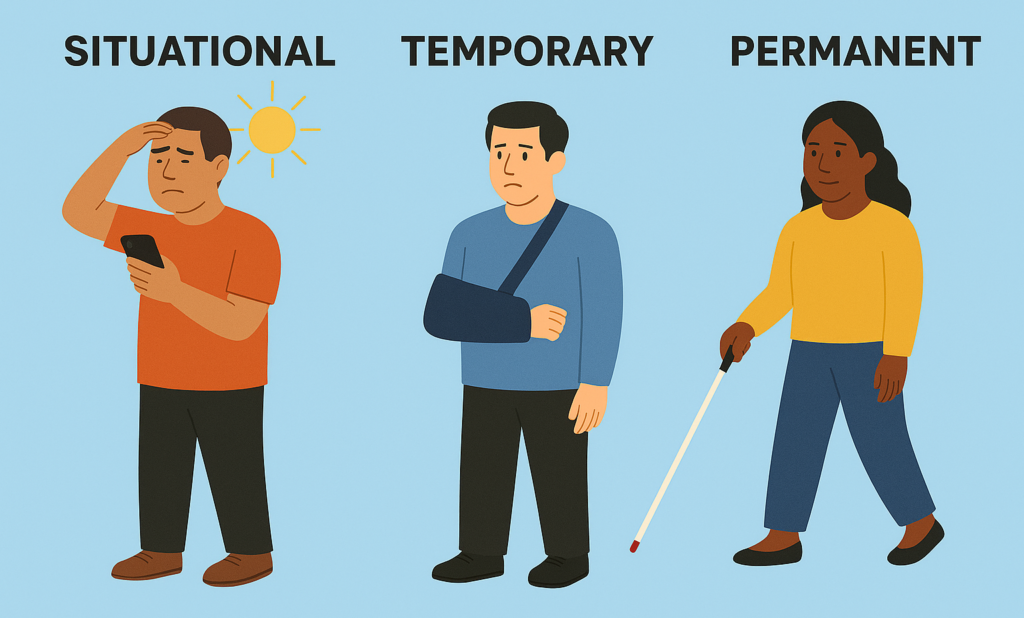
Do you design and code accessible websites for the sake of people with disabilities, such as those who are vision-impaired? Many will answer “yes” to this question, and of course that’s not wrong. Accessibly coded web services are essential for users with permanent disabilities. But here’s something which is often overlooked: Accessible design is for everyone.
This is true for two key reasons:
- Accessibly coded web applications are simply better. When we follow standards such as WCAG and good coding practices, including semantic markup, proper labeling, keyboard navigation, clear contrast, and predictable interactions, we create experiences that are smoother, clearer, and more intuitive for all users. Accessibility is usability.
- Every person experiences disability at some point. Disability is not a binary state. It exists on a spectrum, and everyone moves along that spectrum throughout life. Accessible design definitely supports users with permanent disabilities, but it also supports those facing short-term or context-driven limitations.
Situational disability
A situational disability is a short-term limitation caused by external circumstances. Examples:
- You’re in bright sunlight and find it hard to see your screen.
- You need to operate a device while holding a baby.
- You’re in a loud place and can’t hear sounds on your device. Or the opposite: you’re in a quiet place and must keep the sound off.
Temporary disability
A temporary disability is a short-term physical or cognitive impairment that will resolve over time. Examples:
- You have a broken arm.
- You have an eye infection making your vision blurry.
- You are recovering from surgery and are unable to move the way you are used to.
- You have had a concussion and it’s affecting your concentration abilities.
Permanent disability
A permanent disability is a long-term impairment, acquired at any point in your life. Examples:
- You are vision impaired since birth, or due to an incident, or simply due to old age.
- You are hearing impaired since birth, or due to an incident, or simply due to old age.
- You have a limb difference, since birth or caused by accident or illness.
- You have a neurodivergence such as autism.
Accessibility is for everyone
If you think accessibility is for “other people”, think again. Any one of us can find themselves in a tricky situation, become ill or injured, or simply face challenges when growing old. By building with accessibility in mind, we support our present selves, our future selves, and all the people who interact with what we create.
The post image is an illustration of different kinds of impairments generated by Copilot AI.
Leave a Reply