
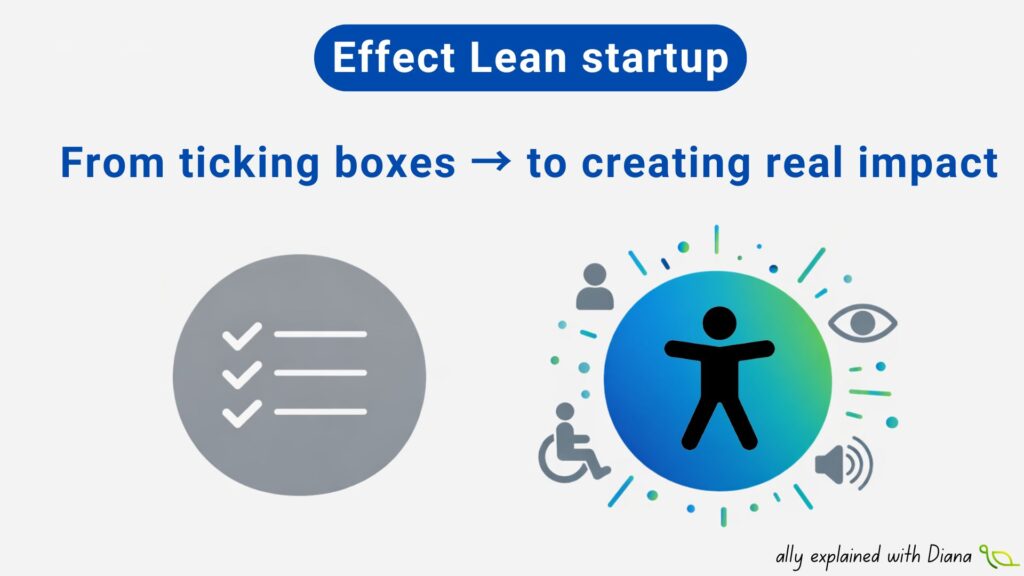
Most organizations treat web accessibility like a compliance checklist: “We fixed WCAG issues, tick.” But compliance alone doesn’t tell us whether people’s lives are actually better because of it.
That’s where Lean Impact comes in. Unlike traditional methods focused on outputs (e.g., number of pages fixed), Lean Impact prioritizes real outcomes – how accessibility changes actual user experience and lives. For example, instead of saying “we resolved 100 issues,” we ask: “Does people’s engagement, comprehension, or quality of life improve because of these changes?”.
What it actually means: Lean Impact adapts the Lean Startup philosophy (Build–Measure–Learn) for social change and impact work. It encourages:
- Small, testable interventions (Minimum Viable Intervention)
- Rapid measurement of real effects
- Learning and iterating based on data
- Pivoting when something doesn’t work
In contrast with compliance‑focused methods, Lean Impact forces us to measure effectiveness rather than effort.
Example: Instead of just adding alt text everywhere, we pilot alternate text styles in a specific user group, measure how it affects scan‑readability and comprehension, and refine based on real feedback.
Traditional accessibility efforts often rely on automated checkers or expert reviews. These are valuable for identifying issues, but they don’t show whether users benefit. A psychophysiological study, for instance, found that accessibility features significantly improved cognitive engagement and reduced mental fatigue, not just for people with disabilities, but for all users. That underscores how measuring human impact (not just code fixes) delivers real value.
Lean Impact vs traditional accessibility methods
| Traditional accessibility | Lean Impact approach |
|---|---|
| Counts errors and compliance metrics | Measures user outcomes (engagement, comprehension, inclusion) |
| Big audits, slow fixes | Rapid, small tests (like Lean Startup MVPs) |
| Compliance as goal | Meaningful change as goal |
| Often static — done once | Continuous iterate/test/improve |
| Outputs (reports) | Outcomes (did it help real people?) |
With Lean Impact, the question isn’t “Did we fix WCAG errors?”, it’s “Did this change improve inclusive access and how do we know?”
What this looks like in practice
🔹 Prototype testing:
Instead of rolling accessibility changes site‑wide, we launch pilot tests on a subset of pages and gather actual user feedback.
🔹 User‑centered measurement:
Ask real users: “How did this change affect your experience?” Qualitative responses are as important as quantitative data. For example, simple scales like “My ability to complete tasks improved significantly” provide immediate evidence.
🔹 Iterative refinement:
If a change isn’t showing clear benefits, we pivot – just like a product team. Lean Impact gives us permission to fail fast and learn faster.
Web accessibility shouldn’t be about ticking boxes. It should be about actual inclusion and human experience.
By embracing Lean Impact we ask better questions like:
🔹 Are our changes helping people engage more fully?
🔹 What evidence do we have and what are we learning?
🔹 How do we adapt our approach when initial assumptions are wrong?
Let’s move accessibility beyond compliance toward real impact.
Leave a Reply to Weekly Reading List December 22 2025 – OZeWAI Cancel reply