
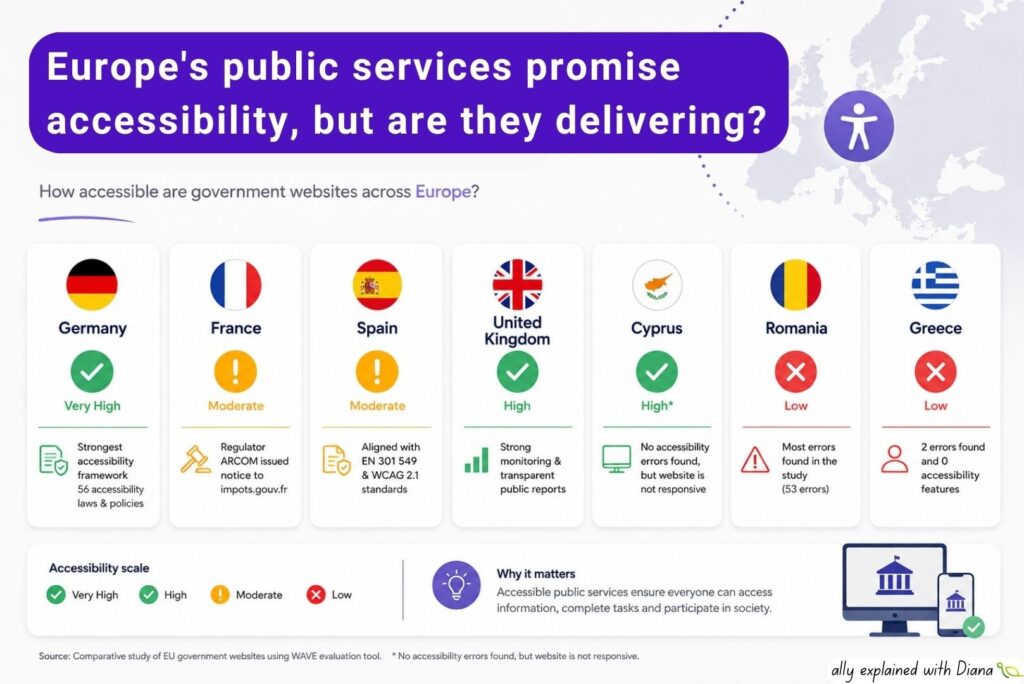
Just a few days ago, France’s digital regulator ARCOM issued a formal notice to the Ministry of Economy and Finance because impots.gouv.fr – one of the country’s most important public service websites – doesn’t fully meet accessibility requirements.
For many people, it was surprising news. France has one of Europe’s most established accessibility frameworks, and yet one of its flagship public services is still facing accessibility issues.
But perhaps the real question isn’t “Why France?”, but “How accessible are public services across Europe?”.
After all, governments are asking citizens to do more and more online – file taxes, apply for benefits, book medical appointments, renew passports, register businesses, pay local taxes, and much more. If these services aren’t accessible, millions of people can face unnecessary barriers.
Accessibility has been required for years
One thing is worth remembering: digital accessibility isn’t a new requirement. The EU adopted the Web Accessibility Directive back in 2016, requiring Member States to introduce accessibility requirements for public sector websites and mobile applications.
The rollout followed a clear timeline:
- 23 September 2019 – new public sector websites had to comply.
- 23 September 2020 – existing public sector websites had to comply.
- 23 June 2021 – public sector mobile apps became subject to the same rules.
In other words, by now public organisations have had several years to improve their digital services.
The Directive didn’t introduce a completely new concept either – it builds on the UN Convention on the Rights of Persons with Disabilities (UNCRPD) and makes those commitments more practical by requiring compliance with WCAG 2.1 Level AA and regular monitoring.
France: a reminder that accessibility is never “finished”
The recent case involving impots.gouv.fr shows something many accessibility professionals already know:
- Accessibility isn’t a project you complete once.
- It’s something that has to be maintained.
- Websites evolve.
- New content is published every day.
- Forms change.
- Documents get uploaded.
- Videos are added.
Without regular testing and continuous improvement, accessibility can gradually decline, even on websites that were once compliant. The French case is also interesting because it shows regulators are becoming more active in enforcing accessibility requirements instead of simply publishing recommendations. That’s an important signal for every public organisation in Europe.
What does research tell us about accessibility across Europe?
While individual enforcement cases attract attention, they don’t tell the whole story.
A comparative academic study analysing official government websites across EU Member States found considerable differences in how accessibility has been implemented. Using the WAVE accessibility evaluation tool, the researchers compared accessibility errors, accessibility features and national policy frameworks.
One finding stood out immediately: Germany was identified as the country with the strongest accessibility policy landscape, with 56 accessibility-related laws and policies. Its official government website completed the evaluation without detected accessibility errors, something the researchers linked to Germany’s long-standing commitment to accessibility, including the Barrier-Free Information Technology Ordinance (BITV) introduced in 2002. At the other end of the spectrum, Romania’s government website recorded the highest number of detected accessibility errors in the study, while Greece’s website showed relatively few detected errors but lacked accessibility features that help users personalise their browsing experience.
It’s important to remember that these findings reflect the websites analysed at the time of the research. Government websites change regularly, but the study provides valuable insight into the different levels of accessibility maturity across Europe.
Different countries, different approaches
One of the most interesting parts of the research wasn’t the number of errors – it was how differently governments approach accessibility.
For example, Bulgaria and Croatia include accessibility options such as text resizing and contrast controls directly on their websites. Lithuania offers a dedicated accessibility version of its government portal, allowing users to increase text size, change colours and simplify the interface. Estonia has taken a different route by encouraging users to rely on the accessibility features already built into modern browsers and operating systems instead of providing its own accessibility widget. Malta goes even further. Its accessibility statement explains that browser and operating system accessibility features are generally more powerful and flexible than website widgets, which can become outdated or poorly maintained over time.
These examples show that there is no single European approach to accessibility. Some governments invest in dedicated interface tools, while others focus on ensuring compatibility with assistive technologies and built-in accessibility features.
Germany, Spain and the UK: different paths towards accessibility
Germany’s approach demonstrates how accessibility can become part of broader digital transformation. Accessibility requirements are increasingly integrated into procurement, development and public digital services rather than treated as an afterthought.
Spain has also developed a comprehensive legal framework aligned with European standards such as EN 301 549, supported by national guidance that helps public organisations understand and implement accessibility requirements.
Although no longer part of the European Union, the United Kingdom remains an interesting benchmark. The Government Digital Service publishes detailed accessibility monitoring reports, openly documenting common issues found during audits and the improvements organisations are expected to make.
This level of transparency benefits the wider accessibility community because it helps organisations learn from recurring problems instead of repeating them.
The same problems keep appearing
Despite years of legislation, the research found that many accessibility issues are surprisingly consistent across government websites.
Among the most common problems were:
- missing alternative text for images;
- linked images without alternative text;
- empty links and buttons;
- missing form labels;
- missing language (
lang) attributes; - empty headings;
- broken ARIA references.
These aren’t complex problems requiring new technology or artificial intelligence. They’re fundamental accessibility practices that have been recommended in WCAG for many years. The study also identified common alerts such as skipped heading levels, redundant links and duplicated titles – issues that can significantly affect users of screen readers and keyboard navigation.
Accessibility is more than passing an automated test
Automated testing tools such as WAVE are incredibly valuable, but they only tell part of the story.
For example, the research noted that Cyprus’ government website completed the automated evaluation without detected accessibility errors but was not fully responsive across different screen sizes.
That’s an important reminder that accessibility isn’t simply about reducing the number of automated errors.
Real accessibility also depends on usability, responsive design, keyboard navigation, meaningful content, clear language and testing with real users who rely on assistive technologies.
Looking ahead in the future
Europe has one of the strongest legal frameworks for digital accessibility in the world. The challenge is no longer writing new legislation, the challenge is making accessibility part of everyday practice.
The recent French enforcement action, together with research comparing accessibility across European governments, reminds us that progress is being made, but there is still work to do.
Accessibility is an ongoing commitment to designing public services that everyone can use, regardless of age, ability or the technology they rely on. As governments continue to digitise more services, accessibility will increasingly become one of the clearest indicators of digital quality and perhaps that’s the most important lesson of all.
Leave a Reply