
After eight years working as a web developer and web accessibility specialist in France, I moved to Sweden this year and started a new chapter in my career. I expected to discover a different professional landscape. What I’m finding is a more interesting question: what changes when the principles of accessibility stay the same, but the systems around them change?
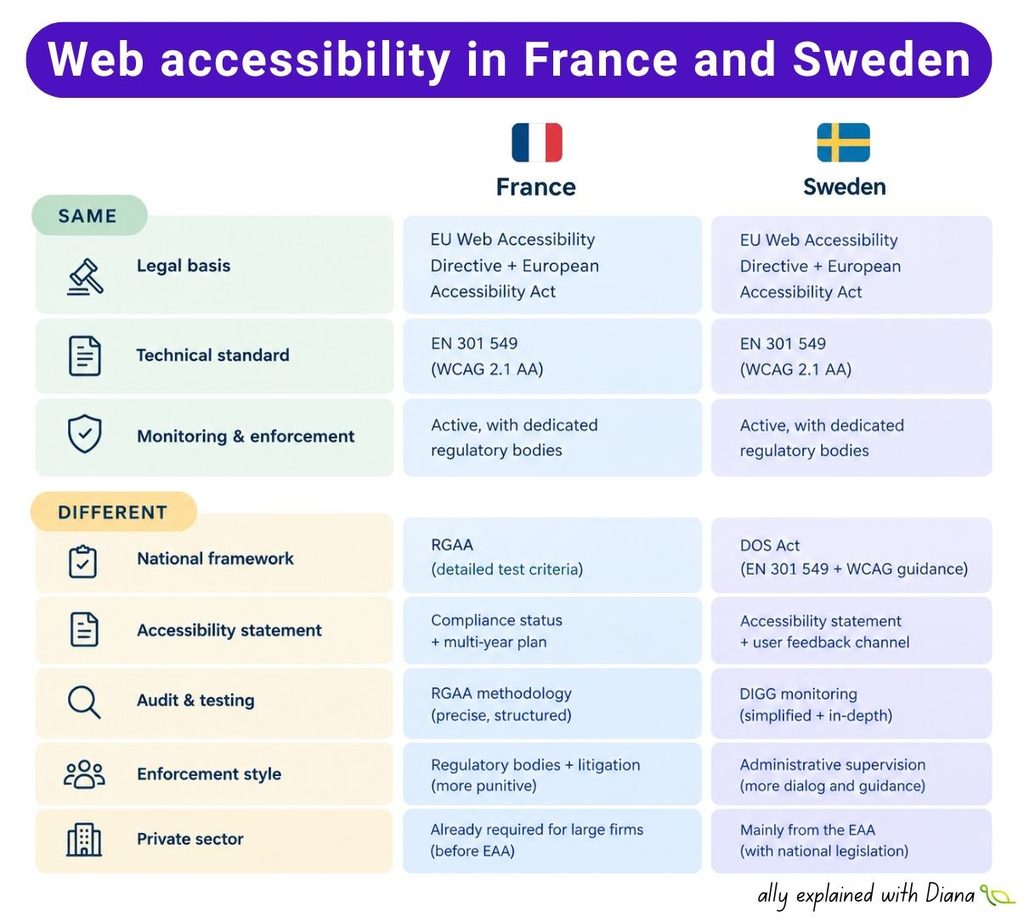
Let’s explore together what France and Sweden have in common, where their approaches differ and what these differences might teach us about making accessibility work in practice. I would like to notice that my experience in France spans several years, while my experience in Sweden is still developing. The legal frameworks provide a useful starting point, but they cannot tell us everything about how accessibility is actually practised inside individual teams.
1. The technical principles are shared, but the national frameworks are not.
At first glance, France and Sweden have a great deal in common.
Both are EU member states. Both are subject to the European Web Accessibility Directive, which establishes accessibility requirements for public-sector websites and mobile applications. Both use the European standard EN 301 549 in the relevant public-sector framework, drawing on WCAG for web accessibility.
Both countries also have national legislation, monitoring arrangements and requirements for accessibility information to be published. But a shared European foundation does not mean identical implementation.
In France, the RGAA – Référentiel général d’amélioration de l’accessibilité – provides a detailed national framework for evaluating digital accessibility. It translates technical requirements into criteria and tests that can be applied during an audit.
In Sweden, the DOS-lagen – the Act on the Accessibility of Digital Public Services – establishes the legal framework for covered public digital services. DIGG, the Swedish Agency for Digital Government, monitors compliance using EN 301 549 and its associated testing procedures.
This distinction matters to practitioners. When I worked with the RGAA in France, I could use its test methodology to structure an audit, document individual failures and communicate concrete corrections to a development team. It gives accessibility work a common vocabulary and a relatively explicit audit structure. In Sweden, I am learning to navigate a different national framework and its official guidance, even though many of the underlying technical questions are familiar.
The important distinction is that the RGAA is not a competing accessibility philosophy to WCAG. It is a national framework for applying and assessing accessibility requirements. Likewise, Sweden is not operating without national rules simply because it uses a European technical standard.
The interesting difference is not whether accessibility has rules. It is how those rules are translated into the work organisations have to do.
Official references:
2. An audit is not just a technical assessment, it is also a way of organising work.
One thing I appreciate about the French RGAA is the level of detail it brings to accessibility testing. A structured methodology helps auditors explain exactly what has failed, where the problem occurs, and what needs to change. It can make the findings more actionable for developers and easier to compare across different parts of a product.
For example, saying that a website is difficult to use with a screen reader is useful as a general observation. Identifying a missing accessible name, explaining which control is affected, and documenting how it prevents someone from completing a task gives a team something concrete to fix.
A detailed framework can also help organisations avoid reducing accessibility to a vague promise or a subjective opinion.
But there is another side to this: a detailed audit can produce a long list of failures without ensuring that anyone has the time, budget or responsibility to fix them. An organisation can become very good at documenting accessibility problems while remaining slow at resolving them.
The existence of a test does not guarantee that a product team will act on the result.
Sweden’s oversight model also relies on structured testing. DIGG conducts simplified and in-depth monitoring of public digital services and can take formal supervisory action when requirements are not met. It would therefore be misleading to describe Sweden as a country where accessibility is approached informally or without rigorous evaluation.
What interests me more is how organisations connect the audit to their development process. Who owns a finding? Is it added to the backlog? Does it become a regression test? Is there a budget for remediation? Does someone verify the correction? And does the same problem reappear in the next release? These questions matter in both countries.
The real measure of an audit is not the number of problems it identifies. It is whether those findings lead to lasting changes in the product and the way it is built.
3. Accessibility statements are more than legal documents or at least, they could be.
France and Sweden both require covered public-sector organisations to publish accessibility information.
In France, the framework includes an accessibility statement, a multi-year accessibility plan and an annual action plan. The statement identifies the service’s compliance status and communicates the results of the assessment.
In Sweden, covered organisations must publish an accessibility statement describing the accessibility of their digital service. Users should be able to report accessibility barriers, and they can also contact DIGG about shortcomings in public digital services.
The details differ, but the underlying purpose is similar: accessibility should be visible, its status should not be hidden, and users should have a way to raise problems.
Yet there is a question worth asking in both countries: who is the statement really for?
For an organisation, it may be a legal obligation. For an accessibility specialist, it may be a summary of audit findings. For a person trying to complete an important task, it may be the only indication that the organisation recognises the problem they are experiencing.
Imagine someone who cannot submit an application because a form control is inaccessible. A statement saying that the website is only partially compliant may be transparent, but it does not resolve the barrier.
What makes the statement useful is what happens around it: a working feedback channel, a response from someone who can help, an accessible alternative where needed, and a process for fixing the underlying problem.
A statement should not become a substitute for accessibility. Nor should it be treated as proof that every user can complete every task.
It is an opportunity to make responsibility visible.
4. The European Accessibility Act changes the conversation beyond the public sector.
For a long time, discussions about digital accessibility in Europe were strongly associated with public-sector websites and services.
The European Accessibility Act (EAA), whose requirements began applying on 28 June 2025, brought additional accessibility obligations to a range of products and services offered to consumers. Depending on the activity and applicable exceptions, this includes areas such as e-commerce, banking services, electronic communications and certain transport-related services.
Both France and Sweden have implemented national legislation for the relevant areas. In Sweden, the legislation commonly referred to as tillgänglighetslagen (LPTT) covers specified products and services, with several authorities responsible for supervision. In France, the EAA operates alongside the country’s existing disability and digital-accessibility legislation.
This matters because the private sector is not one uniform category. A small organisation selling a simple product online has different resources and responsibilities from a large bank, an e-commerce platform or a public authority. The legal scope, applicable requirements, exceptions and transitional provisions need to be considered for the specific service rather than assumed from the sector name alone.
It also changes the business conversation. Accessibility is no longer something that many organisations can comfortably treat as a concern exclusively for public-sector suppliers or a voluntary enhancement to the user experience. But legal requirements alone cannot create a sustainable accessibility practice.
If accessibility is considered only when a deadline approaches, teams may focus on finding and fixing visible failures. If it is integrated into procurement, design systems, development, content production and testing, organisations have more opportunities to prevent those failures from being introduced in the first place.
This is true regardless of whether the organisation is based in France or Sweden. The EAA makes the question of legal scope particularly important. The more useful question for an organisation is not simply, “Does the EAA apply to us?” It is also, “How do we make accessibility part of the way we develop and maintain our products?”
5. Compliance and accessibility are related, but they are not interchangeable.
This is perhaps the most important point I take from working in digital accessibility. An audit can establish whether a service meets the requirements assessed under a particular methodology. It cannot, by itself, tell us everything about the experience of every person who uses that service.
A technically correct interface may still be confusing. A process may satisfy individual success criteria but require an unreasonable amount of effort to complete. A person may encounter barriers that are difficult to capture in a sample-based audit, especially when several small problems combine during a longer task.
This does not make standards or audits less important. They provide a shared baseline, help organisations identify failures, and support accountability.
But they work best alongside other practices. For example, a team could combine an accessibility audit with usability testing involving disabled people, manual testing with assistive technologies, automated checks in the development workflow, and regression testing after fixes are implemented. The team could also investigate whether people can complete the most important tasks on the service, rather than focusing exclusively on the number of criteria passed.
In both France and Sweden, I want to see accessibility treated not as a final inspection but as a continuous responsibility shared by the people who design, build, procure, manage and maintain digital services. That is where technical compliance can become meaningful improvement.
6. What I am learning from moving between the two countries
I am still discovering how accessibility work is organised in Sweden, so I do not want to draw sweeping conclusions about the professional culture of either country. What I can bring is the perspective of someone who has worked in France for eight years and is now learning to work within another national framework.
One useful lesson from this transition is to separate what is genuinely different from what is simply unfamiliar. The terminology changes. The legislation and oversight structures have their own details. The official documentation and processes are not identical. But the core questions remain recognisable:
- Can people perceive, understand and operate the interface?
- Does it work with their preferred assistive technologies?
- Can they complete essential tasks independently?
- Are accessibility issues identified early enough to avoid costly rework?
- Is someone accountable for fixing them?
- Can users report barriers and get a meaningful response?
These questions cross borders more easily than administrative procedures do.
I also think that working across countries can make accessibility specialists more aware of their own assumptions. When a familiar process is no longer the default, we have an opportunity to examine why it exists, what it does well, and where it could be improved. The French approach has given me experience with a detailed audit methodology and a structured way to communicate technical findings. My work in Sweden is giving me a new perspective on a different legal and institutional context. I expect both experiences to keep informing how I work. I do not think one country needs to be declared the winner.
The more useful exercise is to understand which practices help teams turn legal requirements into accessible products — and how those practices can be adapted without losing the strengths of the systems they come from.
7. What would I like to see more of in both countries?
I would like to see stronger connections between accessibility audits and the decisions that shape products from the beginning.
That means involving accessibility specialists before design and development decisions become expensive to change. It means giving developers practical explanations and reusable solutions, rather than simply handing over a list of failures. It means including disabled people in research and testing, and recognising that no single audit or participant can represent every experience.
It also means treating accessibility as an organisational responsibility.
A developer cannot fix a problem that comes from an inaccessible third-party component if the procurement process does not allow it to be replaced. A designer cannot create an accessible experience if the design system prevents sufficient text resizing or imposes inaccessible interaction patterns. An accessibility specialist cannot create lasting improvement if the organisation has no process for prioritising and validating fixes.
These are not uniquely French or Swedish problems. They are questions about how organisations distribute responsibility and make decisions. The national framework matters, but so does what happens inside the organisation after the legal requirements have been understood.
A new chapter and an open question
The two countries share important European requirements and technical foundations. They also have different national frameworks, oversight structures and administrative processes. Understanding those differences matters, especially for organisations that operate across borders.
But I am increasingly interested in another question: what makes an accessibility framework effective in everyday work?
I am looking forward to learning more from the Swedish accessibility community, while bringing my experience from France into the conversation.
If you work in digital accessibility in France or Sweden, I would love to hear your perspective. What works particularly well in your country and what would you borrow from the other?

Leave a Reply